Share the post "Archaeological excavations by the church of St. George from “Vzvoz” (the road leading up the river bank) in Pskov in 2013"
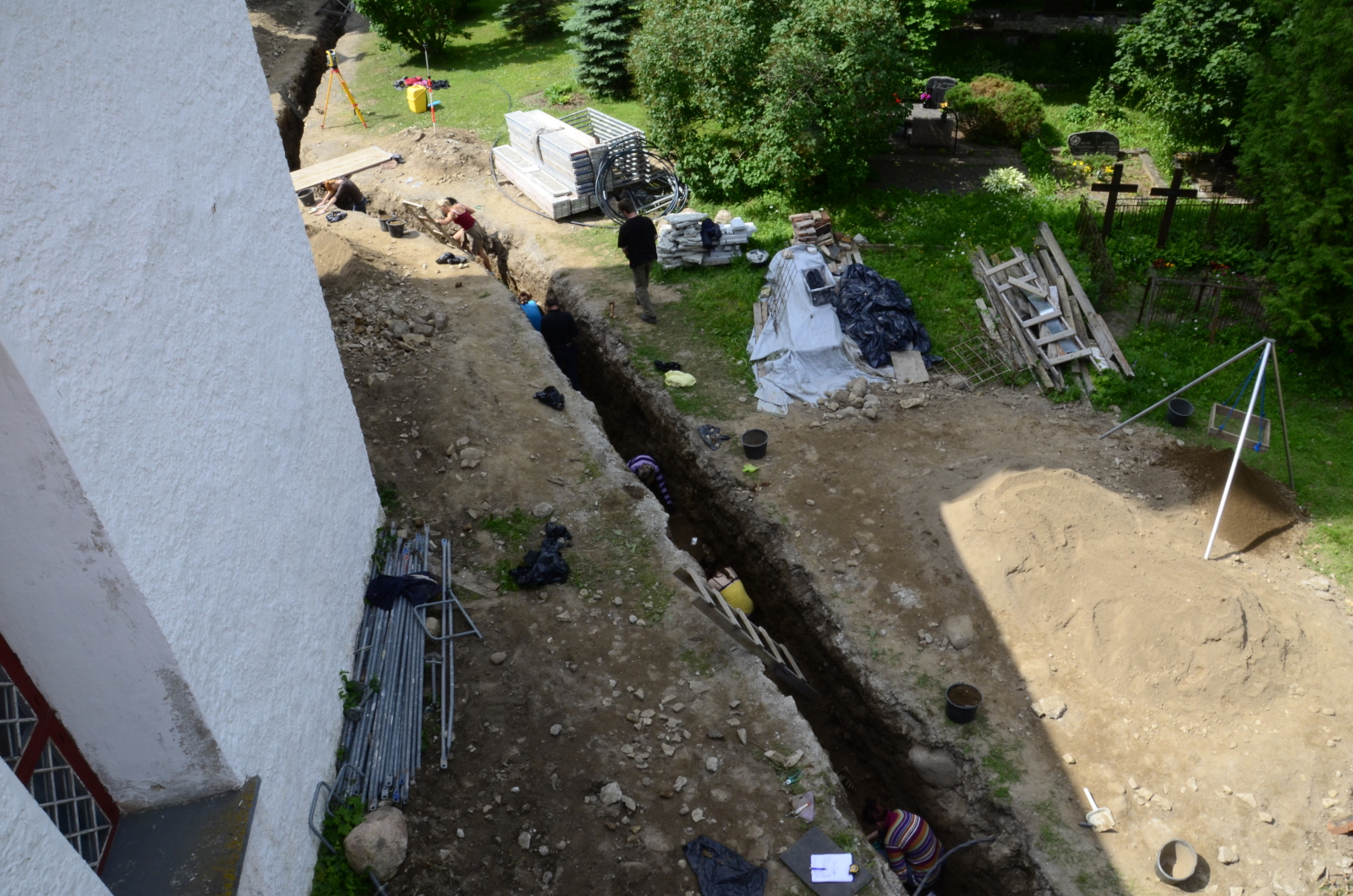
Archaeological research near the church of St. George was carried out in June-July 2013 in connection with the beginning of the church’s restoration and the construction of the utility lines. The author of this article was the director of archaeological excavations.
The church of St. George from the road leading up the river bank, built in 1493/1494 is located in “Polonische” district of ancient Pskov, inside the fifth ring of fortress walls, between Mstislavskaya and Pokrovskaya (Intercession) towers, on the elevated part of the right bank the Velikaya river1. The church has four pillars, three apses and one dome with hidden wall arches. Until 1825 there used to exist a side church of St. Peter the Metropolitan, adjacent to the main church from the north. Adjacent to the church’s southern wall there used to be a narthex with a two sloped roof and a belfry, dismantled in 1831.2 Not far from the church there were Egoryevskiye (St.Georges’) gates in the fortress wall, leading to the river bank.
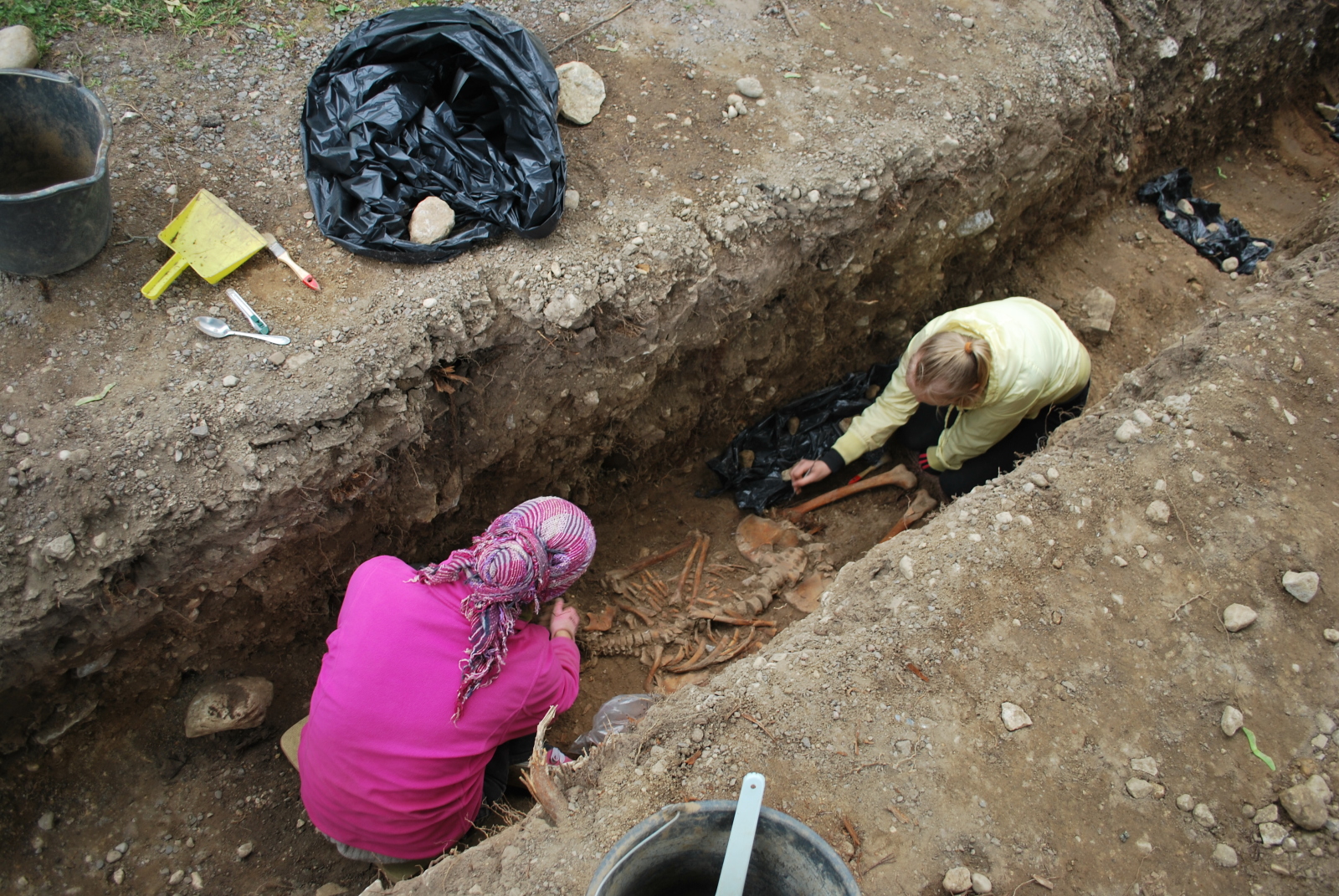
Stone foundations of buildings, adjacent to the main church were found during archaeological excavations. The limestone foundation of a gallery, which used to surround the church from three sides: the northern, the western and the southern, was opened in the III-rd Georgievskiy excavation site on the southern side of the church and in the IV-th Georgievskiy excavation site on the northern side of the church. From the south the width of the foundation was 1,8-1,9 m. In its upper part one can clearly see the lower part of the in-the-wall passage, 0,6 m wide. Probably there used to be an in-the-wall staircase, leading to the initial belfry. The width of the room between the main cube and the inner wall of the gallery was 2,5-2,6 m. Probably right after its construction the gallery began to be used for burials.
On the northern side the width of the gallery’s foundation was 1,3 – 1,4 m. The width of the room between the inner wall of the foundation and the main cube was 4,3-4,4 m. This space was initially also used for burying people, which was done on the same place several times. Later on, possibly, when the north-eastern part of the gallery was turned into the side church of St. Peter the Metropolitan, this part of the gallery was isolated from the rest of the gallery by a stone wall, which began from the south-eastern wall of the main cube. Most probably the side church was warm, since a furnace was attached to its northern wall, its foundation built of limestone slabs with the use of clay mortar having been found in the church.
After quite a long period of time upon the construction of the gallery, during which up to 0,5 meters of the cultural stratum managed to accumulate and the church cemetery was already functioning, a vaulted crypt was attached to the north-western side of the church, built of limestone. Its inner space was 2,6 – 2,7 m wide3.
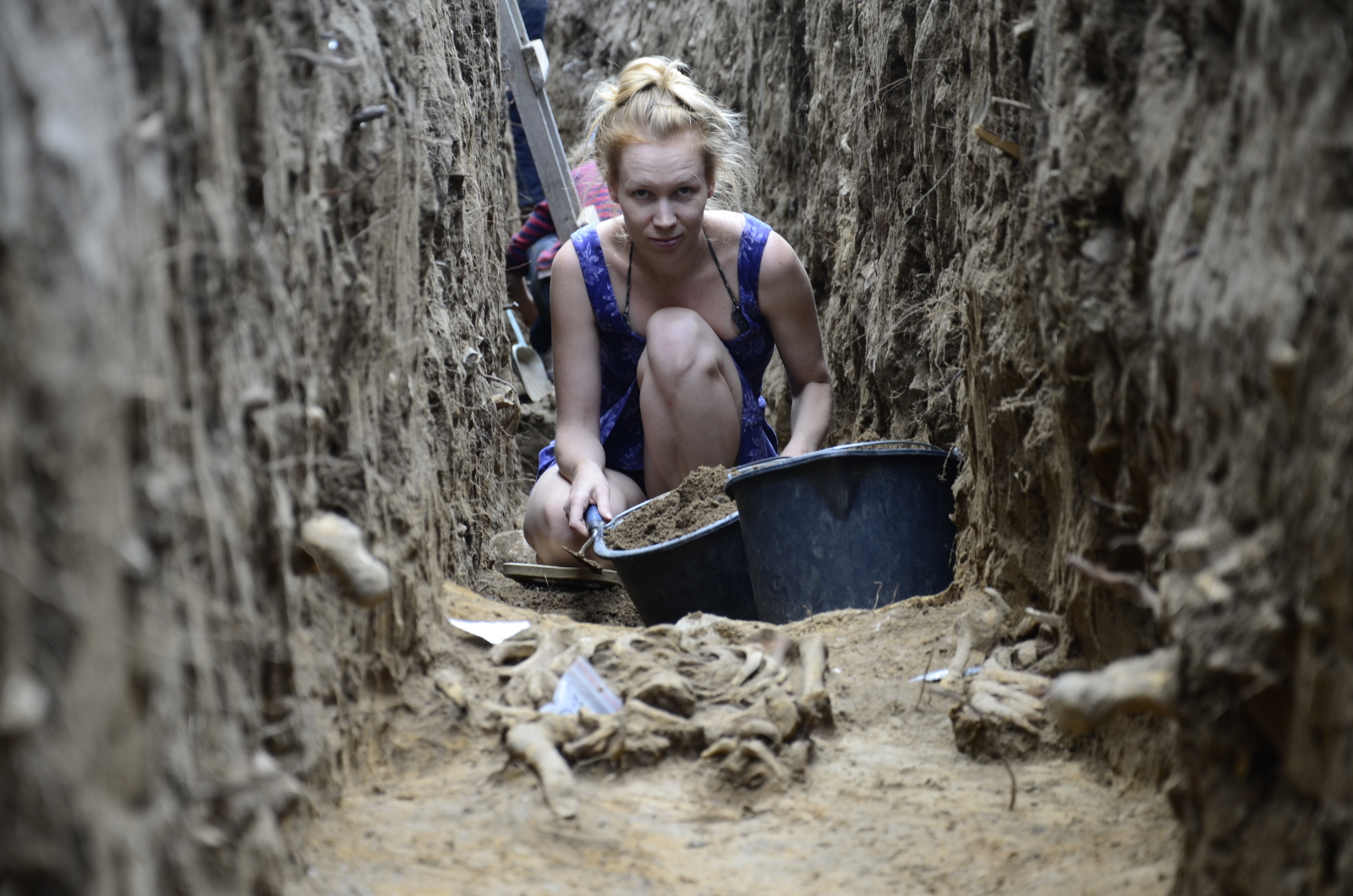
The results of the archaeological excavations near the church of St. George allow us to have a new vision of the history of the church’s construction. Thus, for example, we can assume that the construction of the gallery was the initial plan of Pskov masters, which was suggested by U.P. Spegalskiy4. Not much time passed between the erection of the main cube of the church and the construction of the gallery. Archaeological confirmation to this is the absence of by-the-church burials, made before the construction of the additional volume. Once again archaeological excavations in the church’s gallery have proved that its most probable function was to be a burial vault for rich parishioners, who had been the donators for the church’s construction, and their family members5. A small cemetery used to exist behind the gallery’s wall, from the northern and southern sides of the church. On the church’s southern side the foundation of the cemetery’s fence, built of boulders, was found during archaeological excavations.
Moreover archaeological excavations have once again proved that the drawings of Pskov churches in the icons, depicting Pskov, were realistic. Most correctly the church of St. George from the road leading up the river bank is depicted in the icon from the chapel of Vladichniy krest (the Archbishop’s cross).
During archaeological excavations it was found out that the plot of land, where the church is located, had been already populated in the XII-XIII centuries. The cultural layer from that time was found in the excavation sites, the layer being up to 0,3 m thick. The traces of man’s use of this territory were detected in the numerous ground pits. After the settlement ceased to exist here, people began to get limestone slabs from a quarry on the bank of the Velikaya river, the quarry having been partially revealed in the III-rd Georgievskiy archaeological site. The pit of the quarry, probably, was filled up shortly before the beginning of the church’s construction and the cemetery emerged on its place later on.
Numerous archeological finds come from the 2013 archaeological excavations. Among them are household utensils, jewelry, a lot of XV-XVII centuries copper and silver coins. In the layer of the cemetery many crosses dated XVI-XVIII centuries were found.
Khаrlashov B.N. (Candidate of historical sciences, Senior researcher of Independent non-profit organization “Pskov archaeological center”)